From Breeze to Battle: How “Aura” Became a Street Sport
Eight senses of one word, and the summer of 2026 when it left the screen
QUICK ANSWER
“Aura” kept adding meanings: a breeze (14th century), a subtle emanation (1732), a person’s impression (1859), a spiritual field (1870), a footballer’s mystique (2020), a score on TikTok (May 2024), something to farm (2024–25), and finally a crowd-judged duel. The earliest dated aura championship we could verify took place on 12 June 2026 in Juazeiro do Norte, Brazil; by October 2026 the format had reached French school gates.
Most slang is coined. “Aura” was recycled, and each reuse changed what it counted as. This article follows one Latin word through six centuries, then through the sixteen weeks between 12 June and 3 October 2026, when its newest meaning, the aura battle, went from a TikTok joke to a crowd-judged street duel in at least seven countries. Dates come from the sources listed at the end; where sources disagree, we say so instead of picking the tidier story.
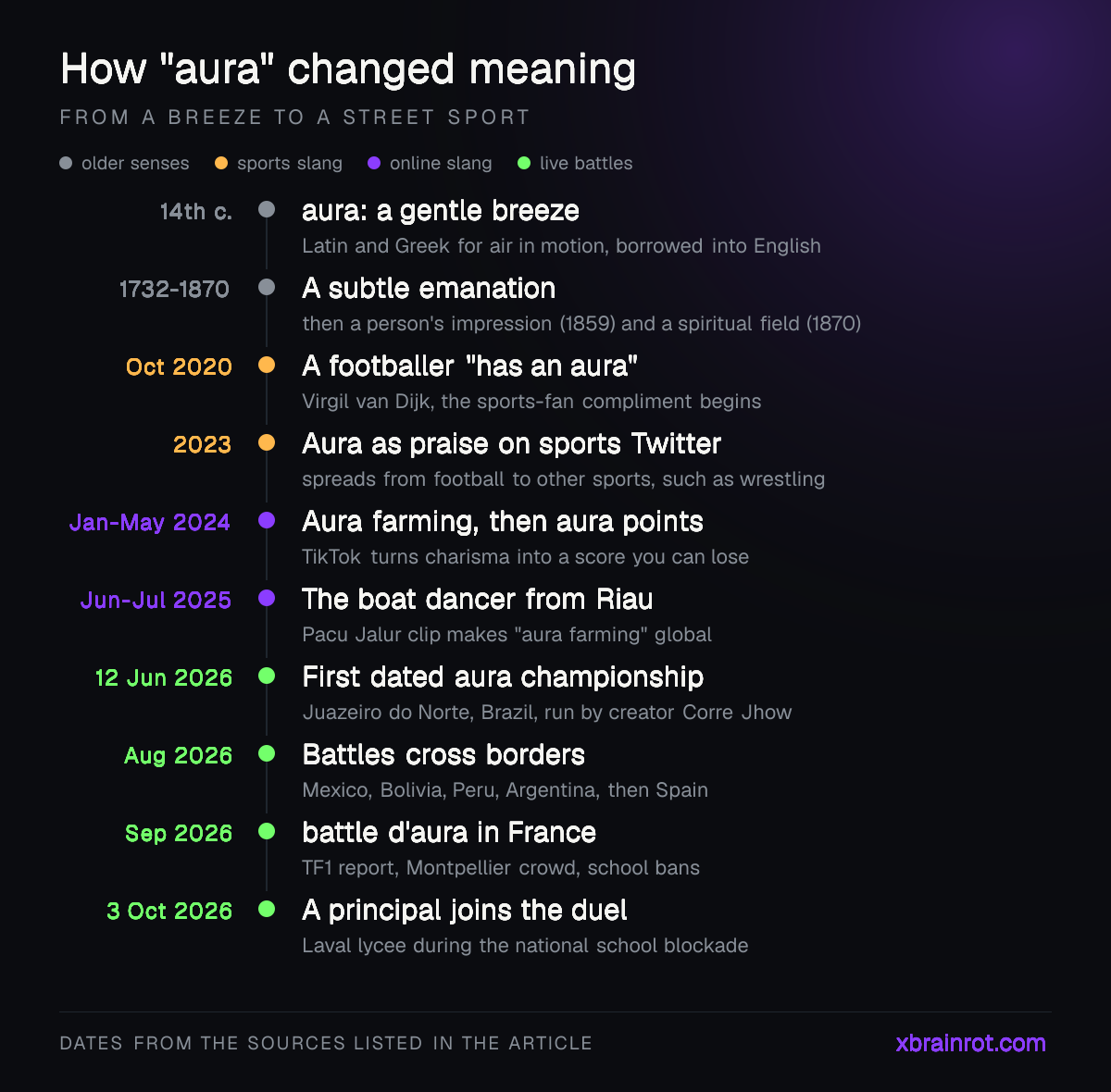
The chain at a glance
Read the graphic from the top. Gray rows are the old senses of the word, amber is the sports-fan compliment, purple is online slang, and green is the live format that appeared in 2026. The sections below take each step in turn.
A breeze, then an emanation (14th century to 1870)
“Aura” comes from Latin aura, “breeze, wind,” which comes from Greek aura, “breath, cool breeze.” English borrowed it in the late 14th century for a gentle breeze. By 1732 it also meant a subtle emanation, such as a smell. In 1859 it could describe the characteristic impression a personality makes, and from the 1840s to 1870 spiritual writers, first Swedenborgians and then spiritualists, used it for a subtle emanation around living beings (Online Etymology Dictionary).
The slang that came later keeps the core of those senses: an aura is something a person gives off without saying a word, and other people feel it.
A footballer “has an aura” (2020 to 2023)
The charisma sense starts in sports talk. It traces to Liverpool defender Virgil van Dijk: a New York Times piece in October 2020 said his mistakes could be dismissed because, basically, he has an aura, and by 8 March 2022 fans on Twitter were joking that he defended with his aura. On 28 January 2023 a tweet noted that “cold” and “aura” posts were being used as compliments, and by September 2023 the word was being applied to wrestlers.
At this stage the meaning is a compliment about presence: calm, unbothered, hard to rattle. It is not yet a number.
Aura becomes a score (2024)
In spring 2024 TikTok turned the compliment into arithmetic. A 16 April 2024 TikTok is on record about a “guy obsessed with having aura” (2.6 million views) and, from the first week of May, videos that award or deduct “aura points” for everyday moments such as a stomach rumbling in class. Its entries differ slightly on who started it: one names a TikTok video of 1 May 2024 as the first aura-points meme it found, another credits a different account on 8 May. Within a month, one school-themed version had passed 26 million plays.
Two things changed. Aura became countable, so it could go up or down, and it moved from athletes to everyone: the template “how many aura points did I lose when…” works for a classroom as well as a pitch.
Farming: from a score to a strategy (2024 to 2025)
If points can be earned, someone will try to earn them. The earliest example of “aura farming” we found is a bowling video captioned with the phrase on 28 January 2024, but the term only took off in September 2024, when an X post about rapper Duke Dennis shaking grapes like Skittles went viral and anime fans began using it to mock characters straining to look cool. By late December 2024 a Reddit thread was staging an “aura off” between Dragon Ball’s Piccolo and Hunter x Hunter’s Killua.
The verb is borrowed from games, where “farming” means repeating an action to accumulate points, as AFP later put it. That is the real shift of this stage: aura stopped being something you have and became something you do, on purpose, in front of an audience. Wikipedia adds that it differs from “rizz” because it carries no romantic meaning.
The boat that took it global (June to July 2025)
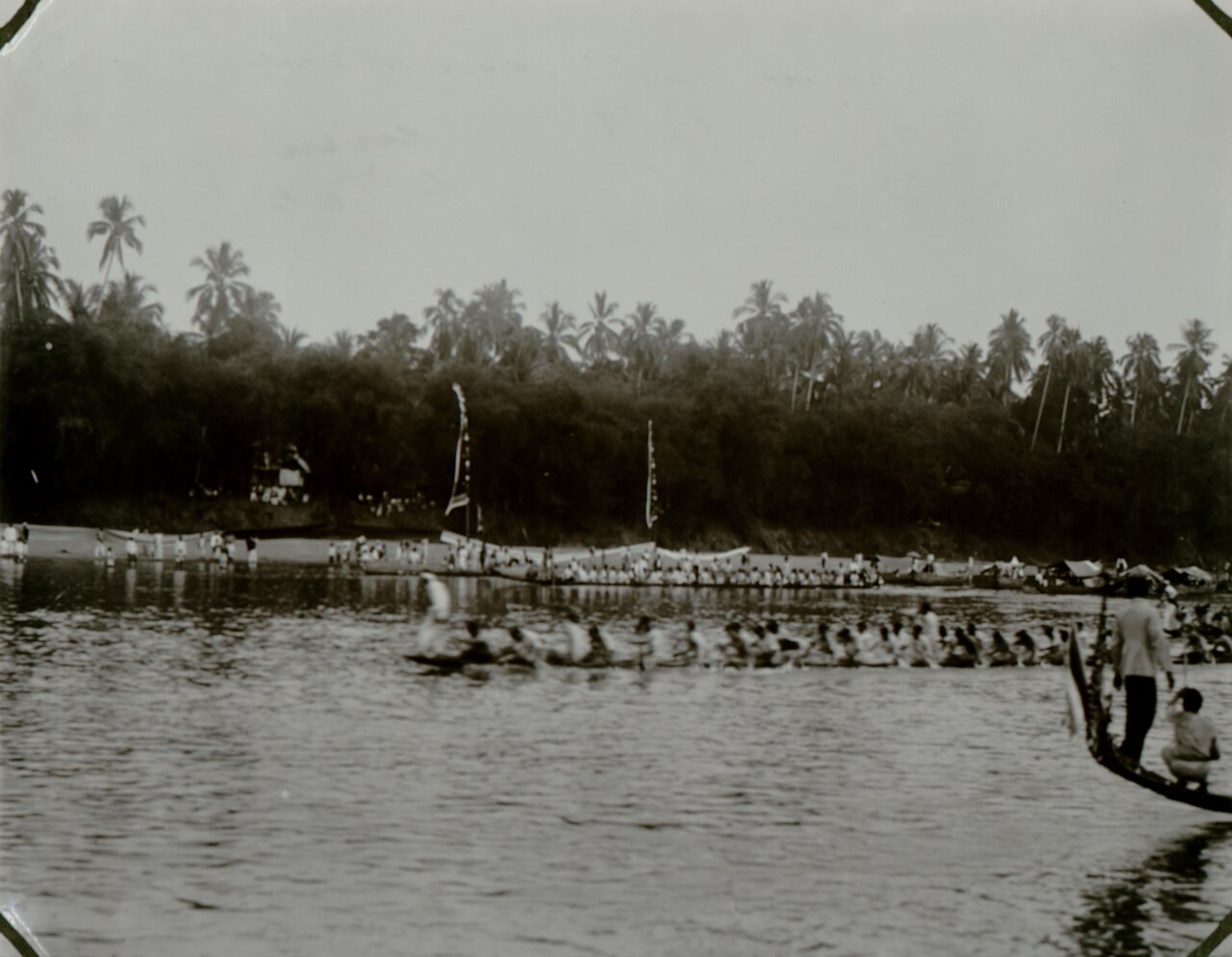
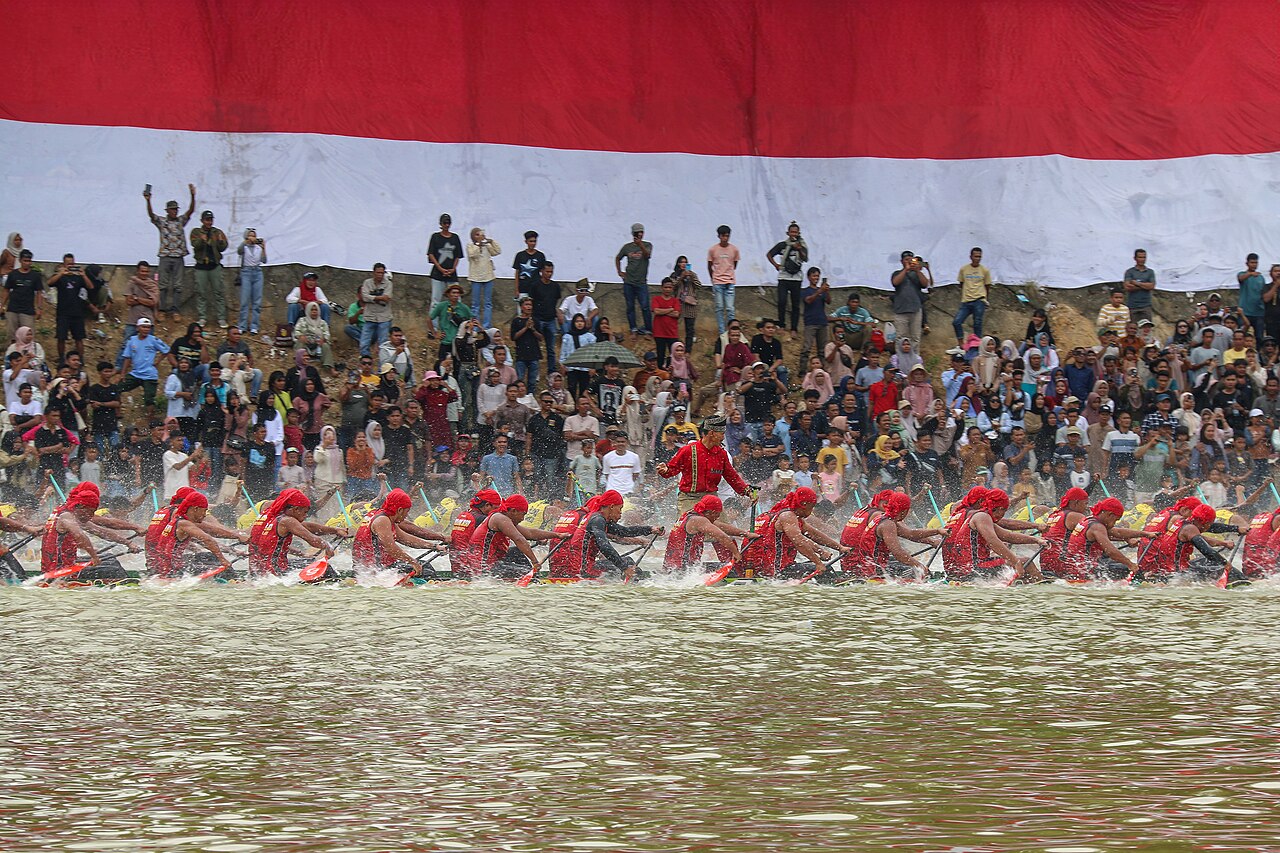
The clip that made “aura farming” a worldwide phrase has nothing to do with TikTok humor. It shows Rayyan Arkan Dikha, described as 11 years old in most reports (some say 9 or 10), standing at the bow of a long racing canoe at a Pacu Jalur race in Kuantan Singingi, Riau, on Sumatra, dancing in time with the rowers behind him. Pacu Jalur is a rowing tradition that goes back to the 17th century; the boats are carved from single tree trunks and carry 50 to 60 rowers, and the young dancer on the bow, the tukang tari or anak coki, gives the crew rhythm and spirit. A 1927 photograph of a canoe race at Teluk Kuantan, then spelled Taloek, shows how old the setting is.
Paired with “Young Black & Rich” by Melly Mike (released 1 June 2024), the clip exploded around the end of June 2025. According to Wikipedia, the song’s US streams rose from about 200,000 in the week of 20 to 26 June to more than 920,000 the week after and about 2.7 million in mid-July. Paris Saint-Germain posted its own version on 1 July, followed by AC Milan, Travis Kelce and Alex Albon, among others, and Riau named the boy a tourism ambassador with a scholarship.
This is where “aura farming” got its model case: composed, unforced, culturally rooted, leading adults, and entirely sincere. Reports quote him saying the movement was spontaneous. He was doing a traditional job, not farming anything, which is exactly why it read as aura.
From metaphor to match (June to August 2026)
Until 2026, aura was a way of talking about people. Then people began competing for it in person. The earliest dated event we could find took place on 12 June 2026, Brazil’s Dia dos Namorados, at Praça do Giradouro in Juazeiro do Norte, Ceará. The local newspaper Diário do Nordeste, reporting on 18 June, says a student and content creator known as Corre Jhow announced a “first farmar aura championship” with AI-generated art that many first took for a joke. His TikTok post passed 60,000 views and videos of the day reached millions. Brazilian Portuguese had already adapted the verb as farmar aura; Spanish speakers say farmear aura.
The format spread within weeks. Mitú reports that a Lima content creator, Fernando Lícito, began organizing battles in Peru in June 2026. By 9 August Unitel Bolivia had posted a battle video on Instagram, one of the earliest recorded examples. On 21 August Euronews reported street battles in Veracruz, Mexico, with prizes of 2,000 and 1,000 pesos and more announced for Xalapa and Mexico City. AFP’s report the next day described battles in Mexico City, Argentina, Brazil, Peru and Bolivia: players, mostly aged 14 to 20, silently strike poses and meme references while a crowd and judges rate meme knowledge, looks, confidence and entertainment. On 22 August teenagers held a battle in Cobija, Bolivia, on the border with the Brazilian state of Acre, and on 23 August Diario de Avisos reported what it called the first documented battle in the Canary Islands, at La Laguna, Tenerife.
The origin is still contested. L’ADN says the trend was born in Brazil in summer 2026; Mitú credits a creator called Uvitinho with the first competition in São Paulo, with no date; other coverage says the exact origin is unknown. We record Brazil as the claimed origin and 12 June 2026 as the earliest dated event, and we treat them as different things.

The preview image is loaded from YouTube when this page opens, so YouTube receives your IP address and browser details, as with any request to another site. The video itself loads only after you click play. Details in our Terms
Crossing into French (September to October 2026)
The word followed the format. French media first treated the aura battle as a Latin American curiosity: L’ADN’s piece of 1 September does not mention France at all. On 23 September TF1 covered “battles d’aura” as duels spreading among young people, which we verified from the broadcaster’s listing and summary rather than the full video. On 25 September a battle announced on TikTok drew a crowd to Place de la Comédie in Montpellier from 11 p.m. to about 1 a.m., and clips went back onto TikTok. By 29 September Collège Sainte-Marie in Riom had banned them after crowds of pupils rushed and pushed to watch. On 3 October franceinfo reported that, outside the blockaded Lycée Ambroise-Paré in Laval during the national school blockade, the principal took part in a battle against a student, and the video spread widely.
The French form, battle d’aura, keeps the English battle and adds the French preposition, a small hybrid of its own.
What the word means now
Seen end to end, “aura” took on five jobs in six years. First a compliment (2020 to 2023): presence you cannot fake. Then a unit (2024): a quantity you can gain or lose. Then a practice (2024 to 2025): something you farm, a verb borrowed from games. Then a model (2025): a sincere, culturally grounded performance that millions imitated. And in 2026 a contest: aura decided by a crowd, in person, which schools and city authorities now have to manage.
What stayed constant, in our reading, is that aura is judged by an audience and never self-declared. What changed is how quickly the audience can answer, from a tweet to a live circle of raised phones.
What we could not verify
Four points where sources disagree or we could not check. First, the origin: see above; no source we read gives a confirmed first battle. Second, L’ADN dates the first championship to June 2025, but the dated Brazilian report puts it on 12 June 2026, so we treat 2025 as a slip. Third, Rayyan’s age and the date of the clip: reports give 9, 10 or 11, and one Wikipedia article dates the song’s viral pairing to January 2025, while its own streaming figures and other reports point to late June 2025. Fourth, a figure of about 5.5 million views for a French creator’s video of 12 September came from a single report we could not open, so we left it out. All pages were read between 4 and 6 October 2026.
SOURCES
- Online Etymology Dictionary: aura — word history and first English senses
- Wikipedia: Aura farming — definition, Rayyan Arkan Dikha, reactions
- Wikipedia: Pacu Jalur — history, boats and the bow dancer
- Wikipedia: Young Black & Rich — release date and streaming figures
- Indonesia at Melbourne: “Aura farming”: how my ancestral village in Riau sparked a global trend (29 July 2025) — Pacu Jalur background and local response
- Diário do Nordeste (18 June 2026) — the 12 June 2026 championship in Juazeiro do Norte
- Euronews (21 August 2026) — Veracruz battles and prizes
- AFP via France 24 (22 August 2026) — countries, rules and judging
- Ecos da Notícia (24 August 2026) — Cobija battle of 22 August
- Diario de Avisos (23 August 2026) — La Laguna, Tenerife
- Mitú (2 September 2026) — Lima organizer and the São Paulo claim
- L’ADN (1 September 2026) — French media first treat it as a Latin American trend
- TF1 Info (23 September 2026) — national TV report
- E-Métropolitain (26 September 2026) — Montpellier, 25 September
- Radio RVA (29 September 2026) — Riom school ban
- franceinfo (3 October 2026) — Laval principal and the school blockade
- Reuters on YouTube: Latin American youth bring aura battles to public spaces — video shown in the article