Italian Brainrot: A Genre Built to Be Remixed
A nine-part study of an AI-made meme genre: how it spread through anonymous accounts, why it peaked in days, and what the data says about its fall
QUICK ANSWER
Italian brainrot is a genre of absurd animal-object characters with pseudo-Italian names, first posted on TikTok in early 2025 by many anonymous accounts. Its English Wikipedia article began on 26 April 2025 and hit 75,009 views on 29 April, about 1.6 times the peak of the Skibidi Toilet article. It then fell faster: under a quarter of its peak within about 11 weeks, against about 44 weeks after peak for Skibidi. By October 2026 it was near 2,000 views a day, and the character articles for Tung Tung Tung Sahur and Ballerina Cappuccina show a sudden step in May 2026 that has no explanation here.
The first three studies in this series followed a date-bound joke, an evergreen prank and a creator’s serial. Italian brainrot is a fourth kind: a genre with no single author. Many accounts posted AI-generated animal-object hybrids with made-up Italian names, and each new character was a copy-able part. The question is what that structure does to attention. This study follows it through nine questions: how it travelled, how fast, in which languages, how attention behaved, whether it came back, how it mutated, who did what, and how sure we can be. The page-view data starts in April 2025, after the genre had already been posted for months, so its first weeks cannot be measured here. Where the data cannot answer a question, the gap is stated instead of filled.
What was measured, and what was not
The attention data is Wikipedia page views from the Wikimedia Pageviews API: daily reads of each article by traffic classified as users (not spiders or automated agents), from the day each article’s series begins to 31 October 2026, pulled on 3 November 2026. The main series is the English article “Italian brainrot”, which begins on 26 April 2025, plus its counterparts in other languages and the English articles on four characters. The English “Skibidi Toilet” and “Brain rot” articles serve as comparisons.
This measures people reading encyclopedia articles. It is not video views on TikTok, not game players, not search interest, and not the amount of posting. The genre’s first months, January to March 2025, come from dated press reports collected on Wikipedia, not from data.
One more caution applies to every series here. A page-view series starts when a title exists as an article. A character that was a redirect, or sat inside a larger article, shows few views under its own title, and views can jump when it becomes its own article. A jump in this data can therefore reflect the article, not only the interest.
1. Propagation path: many accounts, one shared kit
Wikipedia’s summary of press reports gives this chain. In October 2023 users made memes of the actor Dwayne Johnson rhyming “Tralalero tralala”, per Vulture. In January 2025 a TikTok account reportedly posted the first Tralalero Tralala video, was banned, and an AI image of a shark wearing shoes posted on 13 January was reported at 7 million views by the Daily Dot. In February 2025 another account made Tung Tung Tung Sahur, according to the Express Tribune and Hindustan Times.
The press followed within weeks: Afisha on 27 March, Cybernews on 28 March, Daily Dot on 9 April, Il Post and taz on 15 April, Wired Italia and News.com.au on 18 April, and The New York Times on 30 April about Ballerina Cappuccina. Later came Viktor Orbán, then Hungary’s prime minister, posting a video with a 3D Tung Tung Tung Sahur on 28 May, trading cards at Italian newsstands in June, a Roblox game in July and Fortnite items in April 2026.
The pattern differs from the Rickroll and Skibidi Toilet paths. Nobody holds the first move: the chain is a handful of accounts each adding a part, and the first ownership claim in the reporting, a licensing firm’s notice about one character, dates to September 2025.
2. Velocity: ten weeks to the press, four days to the peak
From the first reported video in January 2025 to the first press coverage in late March took about ten weeks. From there the genre was in the news in a dozen languages within a month.
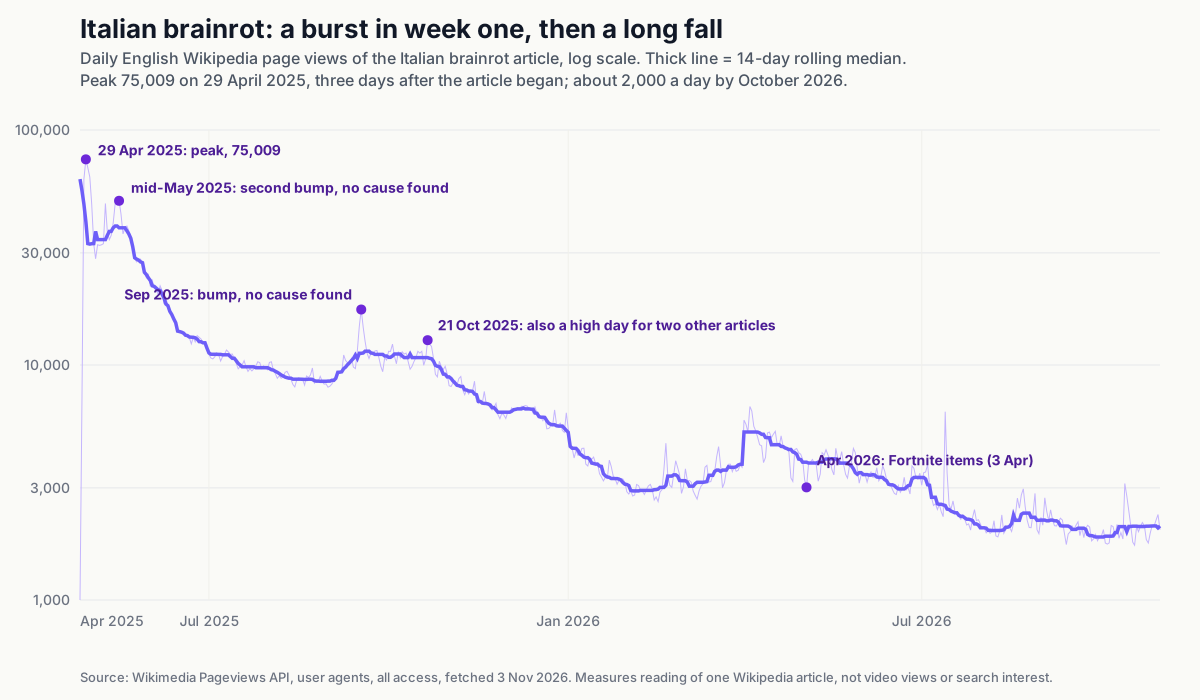
The English Wikipedia article shows how fast attention moved once it existed. It began on 26 April 2025 with 131 views, reached 7,387 on 27 April, 61,823 on 28 April and its peak of 75,009 on 29 April, and was still above 60,000 on 1 May. The Skibidi Toilet article’s biggest day, in July 2024, was 46,391.
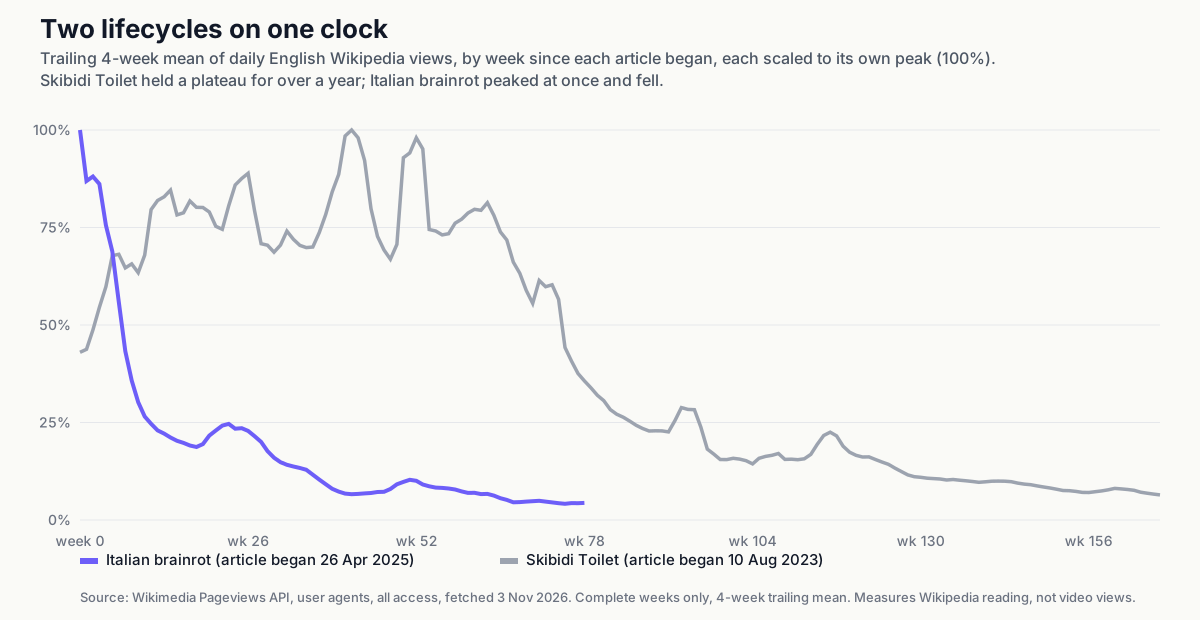
The fall was just as sharp. Monthly means were 36,076 views a day in May 2025, 15,920 in June and 10,359 in July. Scaled to its own peak, the four-week mean was under half after 7 weeks and under a quarter after 11. The Skibidi Toilet article’s four-week mean peaked around week 42 and took 33 weeks to halve and 44 to fall under a quarter.
3. Geographic diffusion: Russian and Italian articles came first, English was largest
The series start dates in the editions measured are Italian (14 April 2025), Russian (20 April), English (26 April), Spanish (27 April), Arabic (1 May), Chinese (3 May), Japanese (4 May), Portuguese (10 May), Polish (17 May), Vietnamese (19 June), Korean (2 September 2025) and French (30 June 2026). Start dates are when an article was created, not when interest began.
The scale is very uneven. The English article averaged 42,692 views a day in April 2025 (five days of data) and 36,076 in May; Russian peaked at 3,538 in May 2025, Spanish at 1,943 in September 2025, Chinese at 484 in August 2025 and Polish at 352 in November and December 2025. Language is not country: readers of an edition live in many places.
The Italian edition is an oddity. Its article began first, yet it averaged 1 to 8 views a day until October 2025 and then 193 in November 2025, with its biggest day, 894, on 20 February 2026. Italian media covered the genre from mid-April, so the small early numbers probably reflect the state of the article rather than the audience. That is a guess, not a finding.
4. Cross-language evolution: the Italian stayed Italian
The characters’ names, such as Tralalero Tralala, Tung Tung Tung Sahur, Bombardiro Crocodilo and Ballerina Cappuccina, are used as they are in the coverage cited, because the pseudo-Italian sound is the joke. What varies is the name of the genre. English, Italian and Vietnamese keep “Italian brainrot”; Spanish and Portuguese use “Brainrot italiano”, Polish “Włoski brainrot”, Russian “Итальянский брейнрот”, French “Brain-rot italien”, Japanese a katakana form, Korean 이탈리안 브레인롯, Chinese 義大利大腦腐蝕 and Arabic a descriptive title meaning absurd Italian internet memes.
The language itself became a topic. Radio France Internationale, in an item on 23 April 2025, called the invented names a bit problematic, and CBC on 6 May 2025 advised translating the Italian before repeating it. Wikipedia also notes that Italian blasphemy appears as a filler word, which is one reason the genre is read differently by Italian speakers than by those who only hear the sound.
Some shared days across languages exist but are small. The Russian article’s biggest day, 28 May 2025 with 9,128 views, matches the date of that video, but the data cannot show a link.
5. Attention curve: a burst, not a plateau
Skibidi Toilet had a year-long plateau. Italian brainrot did not. The first complete week was its peak and the fall began at once, with a slow recovery in autumn 2025 and a steady decline after December. The five biggest days made up 9 percent of the 2025 total, against 4 percent for Skibidi Toilet in 2024, so attention was more concentrated even though the daily level was far above it at the start.
The monthly means in 2026 were 3,770 in January, 3,412 in March, 4,771 in April, 3,787 in May, 2,671 in July and 2,032 in October. The April 2026 rise of about 40 percent over March matches the Fortnite release, which reports date to 3 April 2026. The rise is modest and short.
6. Revival waves: a shared bump in autumn 2025, and a step in May 2026
There is no revival of the article, but two things stand out. In September and October 2025 the English article rose to 17,222 views on 17 September and 12,753 on 21 October, after a monthly mean of 8,865 a day in August. The Brain rot article had its own peak on 18 October 2025 with 20,856 views, and the Skibidi Toilet article’s biggest day that autumn was 21 October with 4,260. Three related articles lifted in the same weeks. No cause was found in the sources used, and Wikipedia’s list for that period shows a Pitchfork piece on 10 September and card displays in October, which do not match the dates.
The second is a step. The Tung Tung Tung Sahur article averaged 124 views a day in April 2026, had 591 on 3 May and 5,928 on 5 May, and then held monthly means between about 4,900 and 6,300 a day through October 2026 with no decay. Ballerina Cappuccina went from about 1 a day in April to 123 in May. The Fortnite release was on 3 April 2026, a month earlier, and a flat level for six months does not look like a fan reaction. A likely reading is that the character articles became standalone pages and began to be found directly in search, but that is a hypothesis about how Wikipedia works, not something the data shows.
7. Remix and mutation: parts that anyone could add
Each character is a module: an animal or object, a pseudo-Italian name, a sound. That makes the genre easy to extend and hard to own, and the documented mutations show it. The characters became trading cards, with Corriere della Sera reporting Skifidol cards at Italian newsstands on 19 June 2025 and L’Espresso comparing them to Garbage Pail Kids two days later. They became a Roblox game, reported by Polygon on 25 July 2025 as Steal a Brainrot, a title which this site’s dictionary records under its own entry. They became a 3D model in a political video, a music subject covered by Pitchfork on 10 September 2025, a meme coin reported in the press in spring 2025, and Fortnite skins in April 2026.
The reaction was not always warm: Forbes reported on 2 April 2026 that Ballerina Cappuccina was Fortnite’s lowest-rated skin, and a Chinese outlet compared children’s enthusiasm to Elsagate in November 2025, both as listed on Wikipedia.
8. Community and creator roles: who did what
Anonymous TikTok accounts made the characters. Press in more than a dozen languages explained them, and the Polskie Radio and Guardian reports in May and June 2025 tied the genre to Generation Alpha. Platforms and game makers turned the characters into products. A French licensing company, Mementum Lab, is reported to have sent a cease-and-desist notice in September 2025 over Tung Tung Tung Sahur, and game studios sued in the US, where the dispute concerns whether an AI-generated character can be owned; Mementum answered with trademark counterclaims in April 2026. Reports describe pending motions and a hearing set for 23 September, and no ruling was found. These are accounts of the parties’ positions and not court findings.
Roles are defined here by what each party did, not by follower counts or audience size, which were not measured.
9. Evidence and confidence: what is observed, what is inferred, what is unknown
A. Observed. The daily and monthly page views in the figures are direct data. The dated events come from named press reports collected on Wikipedia’s Italian brainrot article, which was read in full and is a secondary source; the Fortnite release date and the litigation outline were each checked against at least one further news report.
B. Supported inference. The burst-and-fall shape is shown directly by comparing the two lifecycles on the same clock. The Fortnite release is the likely cause of the modest April 2026 rise, because it fits the date.
C. Hypotheses, not tested. That the Italian-language article’s low early numbers reflect the article’s state rather than the audience. That the May 2026 step in the character articles reflects their becoming standalone pages. That the rise across three articles in autumn 2025 had a common cause.
Unknown. The cause of the 14 to 16 May 2025 and September and October 2025 bumps; the cause of the sudden Japanese rise in August 2026, from 9 views a day in July to 165; what happened between January and April 2025, which this data does not cover; and the outcome of the litigation.
What this shows about reading any meme
With four studies, four shapes emerge. A calendar meme is a date with a step. An evergreen meme is a floor with event spikes. A serial is a rise, a plateau and a decline. A remix genre, like Italian brainrot, is a burst with a fast fall, because no one has a reason to keep a release schedule.
The practical lesson is about what to measure. A genre made of parts peaks when people discover the parts, and it declines when the parts stop being new. Its legal and commercial life, the cards, the games and the court case, can last longer than the attention.
Frequently asked questions
What is Italian brainrot? A genre of AI-generated surreal characters, such as Tralalero Tralala and Tung Tung Tung Sahur, with absurd pseudo-Italian names and narration, that spread on TikTok in early 2025.
Who made it? Many anonymous accounts, each adding a character. The press names the first posters of Tralalero Tralala and Tung Tung Tung Sahur by account, but the genre has no single author.
Is it still popular? English Wikipedia reading of the article is about 5 percent of its first-month level, near 2,000 views a day in October 2026. That measures curiosity about the genre, not whether it is still being posted or played.
Why is there a court case? A licensing company claims rights in the character Tung Tung Tung Sahur, and the reports describe studios asking a court whether an AI-generated character can be owned. No ruling was found.
Final thought
Italian brainrot spread because it was easy to copy and no one had to ask. The data shows what that costs: a peak in the first week, a fast fall, and a long tail kept alive by products rather than by curiosity. The next question is not whether the characters last, but who owns them if they do.
SOURCES
- Wikipedia: Italian brainrot — Dated chronology 2023 to 2026 with the press reports it cites: first posts, April 2025 coverage, cards, Roblox, Fortnite and the rights dispute
- Vice: Fortnite Tung Tung Tung Sahur skin leaked, brainrot set release date — Release of the brainrot set on 3 April 2026
- esports.gg: Tung Tung Tung Sahur in Fortnite — Second report of the 3 April 2026 release
- Plagiarism Today (7 October 2026): Who owns this brainrot character? — Outline of the Tung Tung Tung Sahur rights dispute, including the April 2026 counterclaims
- GamesBeat: Who owns brainrot? Fortnite skin launch renews the debate over AI-generated IP — Second report on the dispute and the Fortnite skins
- Creative Bloq: This weird legal case could change how we think of copyright forever — Report of the September 2025 cease-and-desist and the lawsuit
- Wikimedia Pageviews API: English Wikipedia, Italian brainrot, daily, user agents (query used) — Source of every page-view figure; the other editions, character articles and comparison articles were pulled the same way