Why Mariah Carey “Defrosts” Every November 1
A nine-part study of one meme: its path, speed, languages, attention, returns, remixes, roles and evidence
QUICK ANSWER
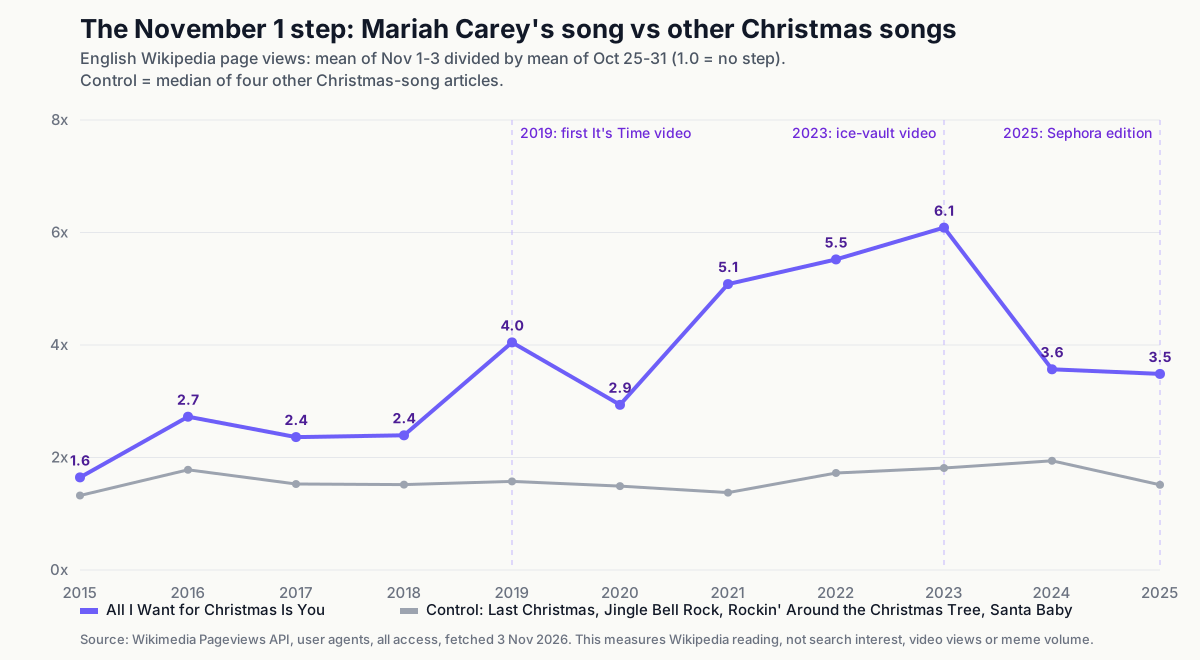
Fans joked from at least October 2017 that Mariah Carey thaws out each year to start Christmas; from 2019 she posted her own “It’s Time” video every November 1. English Wikipedia reading of her song jumps on that date about 4.4 times from 2019 to 2025, against 2.3 times in 2015 to 2018, while other Christmas songs stayed near 1.6. The ice imagery came later, in 2023.
Every year on November 1, timelines fill with the same picture: Mariah Carey frozen in ice, captioned as if Christmas were a machine switched on by her thaw. The joke is so familiar that it reads as one continuous thing. It is not. A fan joke, an artist’s own video tradition, a chart story about one song and, lately, an advertising deal arrived at different times, and they do not all line up with the ice. This study follows the meme through nine questions: how it travelled, how fast, across which languages, how attention behaved, whether it returned, how it was remixed, who did what, and how sure we can be. Where a question can be answered with data, it is. Where it cannot, the gap is stated instead of filled.
What was measured, and what was not
The attention data here is Wikipedia page views from the Wikimedia Pageviews API: daily reads of the song’s article by traffic classified as users (not spiders or automated agents), from 1 July 2015 to 31 December 2025, in ten language editions, pulled on 3 November 2026. The main measure is the November 1 step: the average daily views on November 1 to 3 divided by the average on October 25 to 31. A value of 1.0 means no step.
As a control, the same measure was computed for four other Christmas-song articles on English Wikipedia: Last Christmas, Jingle Bell Rock, Rockin’ Around the Christmas Tree and Santa Baby.
This is a measure of people reading an encyclopedia article. It is not search interest, not views of the videos, and not the amount of meme posting. Google Trends, video view counts and social-post archives were not available for this study, so none of those is claimed.
1. Propagation path: from fans to the artist to the press to a brand
The documented chain is bottom-up. The Daily Dot lists the first appearance as October 2017 on X, with jokes about defrosting Carey also in October 2018, and says its authors could not pinpoint where the idea started. The earliest post anyone has found is not necessarily the first.
On November 1, 2019 Carey posted her own video, captioned “Breaking News”: she wakes in her Halloween costume as the date flips, takes a call from Santa in Christmas pajamas and sings that it is time. From then on she posted one every year, and the press covered each one on the day: Good Morning America, Entertainment Tonight, The A.V. Club and HuffPost UK are among the outlets in the sources below. In 2025 the video was made in partnership with Sephora.
What the sources do not show is a link between the fan posts and the artist’s decision. The sequence is documented; the cause is not.
2. Propagation velocity: days, weeks and years
From the earliest joke found (October 2017) to the artist’s own video (November 2019) is about two years. From that video to the song’s first number one on the Billboard Hot 100 (chart dated December 21, 2019) is six to seven weeks. From 2019 to the first ice scene in the reports is four years (2023), and to the first sponsored edition that a source confirms is six (2025; sponsorship in earlier years could not be verified).
The fastest reaction is within a day. In English Wikipedia the song’s views on November 1 were on average 4.0 times the day before in 2019 to 2025, against 1.9 times in 2016 to 2018. For the four control songs the figure was 1.4 times in both periods.
3. Geography and language: who reacted, and when
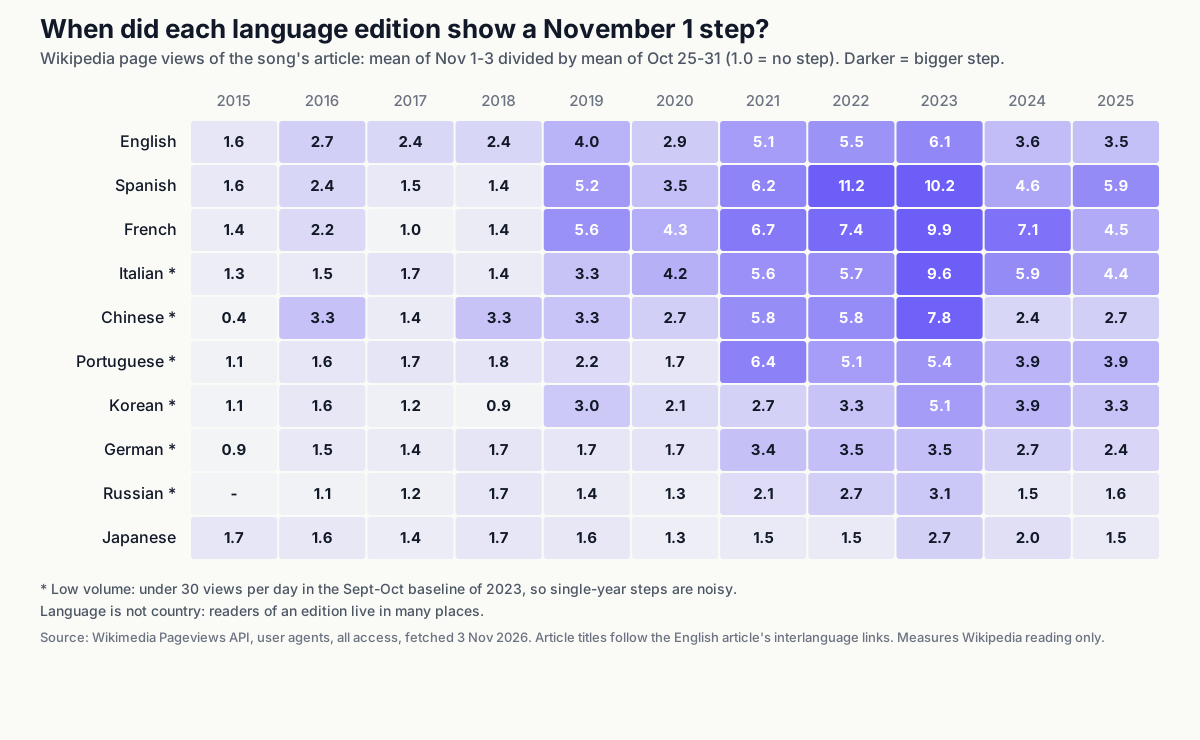
Language is not country, and an edition’s readers live everywhere. With that limit, the editions with enough traffic to read (English, Spanish, French and Japanese; each had at least 39 views a day in the autumn of 2023) split into two groups.
English, Spanish and French show a November 1 step that was small before 2019 and large after. The mean step for 2015 to 2018 against 2021 to 2024 was 2.3 against 5.1 for English, 1.7 against 8.1 for Spanish and 1.5 against 7.8 for French. In 2019, the year of the first video, Spanish went from 1.4 to 5.2 and French from 1.4 to 5.6, the same year as English (2.4 to 4.0). The Japanese edition barely moves: 1.6 in 2015 to 2018 and 1.9 in 2021 to 2024, with a single 2.7 in 2023.
The smaller editions point the same way but are noisy: Italian, Chinese, Portuguese, Korean, German and Russian had 6 to 25 views a day in the 2023 baseline, so one year can swing on a handful of readers. Portuguese and German show little step until 2021 in this data, which is suggestive of a later start and no more. The peak day also differs by edition, and was the same in each of 2022, 2023 and 2024: December 24 in French, German, Korean and Japanese, December 25 in English and Spanish, and December 31 in Russian.
4. Cross-language evolution: the thaw as a metaphor, and as a launch
The English fan metaphor of defrosting crossed into Spanish-language press. SDP Noticias, a Mexican outlet, wrote on November 1, 2023 that Carey “se descongela” to mark the end of Halloween and that her post set off a wave of memes. The French-language coverage in the sources frames the same event differently: Paris Match Belgique’s 2024 headline says she officially launches the Christmas season, and the piece calls it a yearly tradition; the thaw is not in the headline.
That is a difference in framing, not proof of how the idea moved: the sources document coverage in Spanish and French, not local adaptations, translations of the joke by fans, or a different local origin, so none is claimed.
5. Attention curve: a yearly cycle with a sharper left edge
The curve is seasonal, not a single burst. In English Wikipedia the song’s daily views sit near a few hundred through the autumn, jump on November 1 and peak on December 25 in every year from 2015 to 2024 except 2019, when the peak was December 17, the week of the Hot 100 announcement. At the peak the article was read 42 to 107 times as often as in the September to mid-October baseline.
What changed over time is the left edge. The November 1 step averaged 2.3 times in 2015 to 2018 and 4.4 times in 2019 to 2025 (4.8 times in 2021 to 2025). The four control articles averaged 1.5 and 1.6 over the same two periods. A half-life measure does not fit a seasonal curve, so none is reported; the step, the peak-to-baseline ratio and the off-season baseline are the three numbers that do.
The off-season baseline of the song’s article rose from 264 views a day in 2015 to 938 in 2023. Last Christmas rose from 252 to 563 over the same years, so part of that growth is not specific to Carey.
6. Revival waves: recurrence, not revival
A meme that returns on a fixed date is different from one that comes back after fading. Here every November 1 re-lights the same lineage, driven by one calendar trigger and one artist, so the waves are not independent. No second, unrelated origin appears in the sources.
The strength of the wave still varies. The English step was 4.1 in 2019, 2.9 in 2020, 5.1 in 2021, 5.5 in 2022, 6.1 in 2023, 3.6 in 2024 and 3.5 in 2025. Why 2020 dipped is not established by anything we found.
The measure matters for claims about a peak. The Daily Dot dates the meme’s peak popularity to November 1, 2024, while the Wikipedia step peaked in 2023 and was lower in 2024. These do not contradict each other: one is social chatter reported by a news site, the other is encyclopedia reading, and a peak claim is only meaningful with its measure attached.
7. Remix and mutation: who changed what
Four layers can be told apart. The fan layer is the thaw image and caption format, shown in the memes SDP Noticias describes. The artist layer is a yearly formula, a Halloween scene that flips to Christmas, rebuilt with a new costume each time: a Santa call in 2019, a pumpkin smash in 2021, a witch on an exercise bike in 2022, a Morticia Addams look with a partner turned into a snowman in 2024.
The third layer is a loop back. The ice metaphor was fan language in 2017 and 2018 and enters the footage in the reports for 2023, when she is thawed out of a vault with hair dryers. The sequence is documented. That the fan image caused the 2023 scene is an inference, not a finding.
The fourth is commercial: the 2025 Sephora edition, which TODAY reported drew criticism for putting an anti-consumerist song to work selling makeup and for a storyline in which a worker who wants to strike is turned into a snowman. Which variants pushed the original back into view is not something these sources can say, though the ice-vault year, 2023, also had the highest step in the data, 6.1. That is an association only.
8. Roles: fans, owner, amplifiers, brand
The sources show four roles. The early joke makers are anonymous in the sources, so no person can be named as the origin. The artist is the owner of the ritual: she sets the date, the format and the timing around midnight Eastern Time, and she replied to a fan who had noticed rising searches for her song with “Not yet” on October 29, 2020.
The press is the annual amplifier, covering the video the same day in English and, in the sources, in Spanish (Mexico) and French (Belgium). A brand, Sephora, took part in 2025. Roles here are read from what each party did in dated reports, not from follower counts, which cannot show who started something.
9. Evidence and confidence
Observed (A): the October 2017 and 2018 jokes as reported by the Daily Dot; the content of each yearly video as described by contemporaneous reports (the videos themselves were not watched for this study); the first Hot 100 number one in December 2019; the 2025 Sephora edition and the criticism; and the page-view numbers as retrieved.
Supported inference (B): that the larger November 1 step after 2019 is specific to Carey’s song and goes with the video tradition (the control songs did not move); that the first ice scene is 2023 (the reports for other years do not mention one); that the thaw metaphor was absorbed back into the footage.
Hypothesis (C): that the 2019 video helped the song reach number one (the song had already peaked at number three in 2018); that the ice vault drove the 2023 high; why 2020 dipped; why Japanese readers show no step; any claim about the true origin.
Unverifiable here: the original 2017 and 2018 posts, search interest, video views, and a 2024 brand sponsor that search results mentioned but no page we opened confirmed.
What this shows about reading any meme
Three habits came out of this case. State the measure with every peak, because social chatter and encyclopedia reading peaked in different years. Check a control before crediting a cause, because the step before 2019 shows the date already mattered. And separate a recurrence on a calendar from a revival after a decline, because they call for different explanations.
Frequently Asked Questions
When did the Mariah Carey defrosting meme start? The Daily Dot lists October 2017 on X as the first appearance and says the exact origin cannot be pinpointed.
Did Mariah Carey defrost in her 2019 video? According to the report of that video, no: she wakes in a Halloween costume and takes a call from Santa. The first ice scene in the reports is 2023.
Does the video really change attention? In English Wikipedia the song’s November 1 step rose from about 2.3 times before 2019 to about 4.4 times after, while four other Christmas songs stayed near 1.6. That fits an effect of the tradition but does not prove it.
Did the meme spread to other languages? Spanish and French Wikipedia show the same November 1 step from 2019, and Spanish and French outlets cover the video. Japanese Wikipedia shows almost none. Language is not country.
Final thought
The meme survives because it has a built-in date, a willing subject and a song that is present every December. The numbers add a quieter point: the date mattered before the artist took it over, and what she changed was how sharp the edge became. The ice that everyone remembers arrived years after the joke began, and the joke’s first author is still unknown.
SOURCES
- Daily Dot: the defrosting has begun meme (5 November 2024) — First appearance October 2017 on X, early jokes in 2017 and 2018, origin not pinpointed, peak 1 November 2024
- Wikipedia: All I Want for Christmas Is You — 2019 release of the first “It’s Time” video, first Hot 100 number one on the chart dated 21 December 2019, later returns
- CBS News (17 December 2019) — Number one 25 years after the 1994 release; peaked at number three in 2018
- WTVR (1 November 2019) — The 2019 video: Halloween costume, call from Santa, no ice
- HuffPost UK (2 November 2020) — The 2020 video and the 29 October “Not yet” reply
- The A.V. Club (1 November 2021) — The 2021 pumpkin-smashing video
- Entertainment Tonight (1 November 2022) — The 2022 witch-to-Santa video
- Good Morning America (1 November 2023) — The 2023 ice-vault video
- PureWow (1 November 2024) — The 2024 Morticia Addams video; no ice scene
- Good Morning America (1 November 2025) — The 2025 video with Billy Eichner, made with Sephora
- TODAY (4 November 2025) — Criticism of the 2025 Sephora edition
- SDP Noticias (1 November 2023) — Spanish-language coverage from Mexico of the defrosting post and the memes it set off
- Paris Match Belgique (2 November 2024) — French-language coverage describing a yearly tradition and an official launch of the season
- Wikimedia Pageviews API, per-article daily views of the song’s English article (pulled 3 November 2026) — Source of every page-view figure; the other language editions and the four control articles were pulled with the same query form