Why the Rickroll Never Died
A nine-part study of an evergreen meme: how a 1987 song became a 2007 prank, and what Wikipedia reading says about the years since
QUICK ANSWER
Rickrolling grew out of a 2006 4chan prank (duckrolling) and a link posted in May 2007 as a fake Grand Theft Auto IV trailer, reached the mainstream press in 2008, and then lasted because the song’s own artist and many institutions joined in. English Wikipedia reading of the Rickrolling article has a floor of about 1,200 to 4,000 views a day, broken by event spikes of 20 to 100 times that, and a lift of about four times on April 1 that two control song articles do not have. The data starts in July 2015, so the 2007 to 2008 boom itself cannot be measured here.
A Rickroll is a trick that has been exposed for almost twenty years and still works as a joke: a link promises one thing and plays Rick Astley’s 1987 song “Never Gonna Give You Up”. Most memes burn out once everyone knows the trick. This one did the opposite, because knowing the trick became part of the fun. This study follows it through nine questions: how it travelled, how fast, in which languages, how attention behaved, whether it came back, how it mutated, who did what, and how sure we can be. It is the second study in a series. The first, on Mariah Carey’s November 1 “defrosting”, was a meme that returns on a calendar date. This one is different: it has no fixed date of its own, and it returns whenever something gives it a reason. Where the data cannot answer a question, the gap is stated instead of filled.
What was measured, and what was not
The attention data is Wikipedia page views from the Wikimedia Pageviews API: daily reads of each article by traffic classified as users (not spiders or automated agents), from 1 July 2015 to 31 December 2025, pulled on 3 November 2026. The main series is the English article “Rickrolling”, plus the same article in seven other language editions (Spanish, French, German, Japanese, Russian, Portuguese, Italian) and a Chinese edition whose series starts later. English articles on the song, on Rick Astley, and on two unrelated 1980s songs (“Take On Me”, “Africa” by Toto) serve as controls.
This measures people reading an encyclopedia article. It is not search interest, not views of the music video, and not the amount of meme posting. Google Trends, video view counts and social-post archives were not available for this study, so none of those is claimed.
The largest limit is timing. The Pageviews API begins in July 2015, eight years after the first Rickroll and seven years after the peak of its first wave. Everything about 2007 and 2008 below comes from dated press reports, not from data.
1. Propagation path: from a duck to a link to the artist himself
The documented chain has a precursor. Duckrolling, a 4chan prank that swapped a link’s target for a picture of a duck on wheels, took off in 2006 after a word filter on the site replaced one word with another. In March 2007 Rockstar released the first Grand Theft Auto IV trailer, and on 15 May 2007 a 4chan user posted the Astley video to YouTube disguised as that trailer. That is the usual account, summarised on Wikipedia from press reports; some details, such as the uploader and exact date, vary between retellings.
The jump to the mainstream came in 2008. In February Anonymous used the song in protests against the Church of Scientology, which The Guardian reported; in March a New York Times story about a university basketball game was later retracted; on 1 April YouTube itself sent featured-video links to the Astley video as its April Fools’ joke; and in November the singer appeared on a parade float at Macy’s Thanksgiving Day Parade, lip-syncing the song.
The pattern is a path that gets shorter at each step: an anonymous board, a platform, the press, the artist, then institutions. The sequence is documented. Why each step happened is not.
2. Velocity: a slow start, then a week-long half-life
From the first duck prank (2006) to the Astley version (May 2007) took about a year. From the Astley version to the first mainstream coverage in early 2008 took about nine months, and by April 2008 a SurveyUSA poll estimated that at least 18 million American adults had been Rickrolled, according to a 2020 MEL retelling cited by Wikipedia. So the first wave was fast once the press noticed it, and slow before.
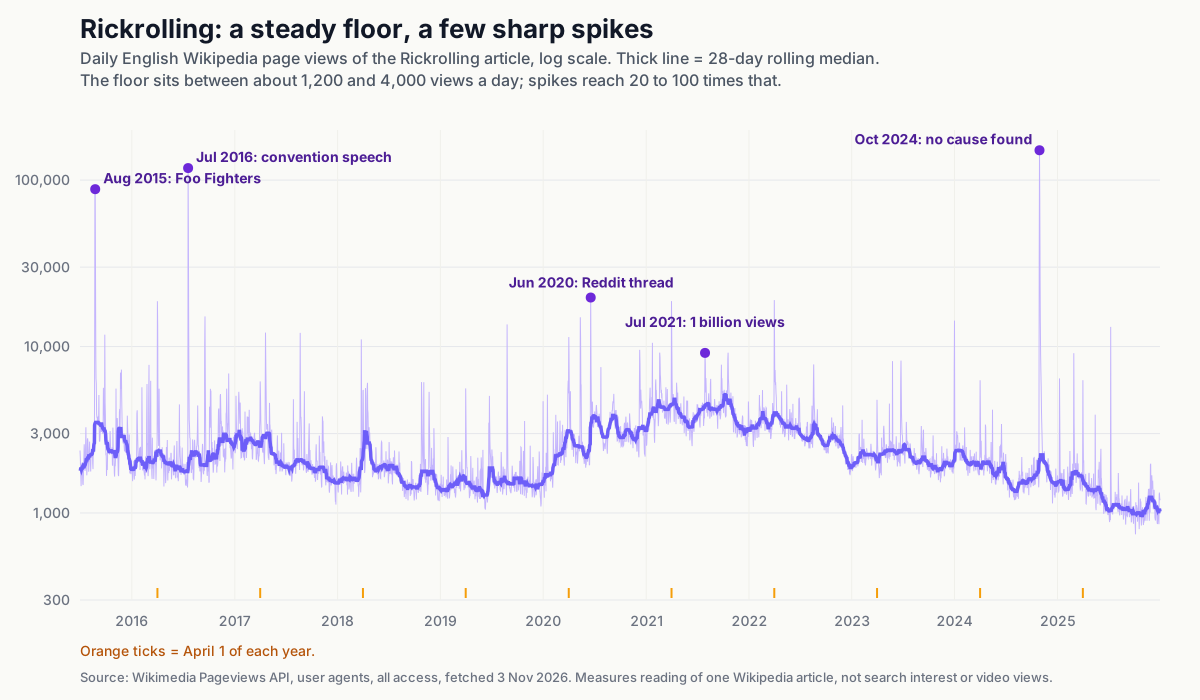
The page views show how fast single events move attention today. Three days after the Foo Fighters stunt of 21 August 2015 the English article went from about 2,200 views a day to 88,201 on 24 August, forty times its floor, and was back under twice the floor within five days. After the July 2016 convention speech the peak was 118,103 views, sixty-five times the floor, with the same five-day return. A spike on 18 June 2020, consistent with the Reddit thread of that month, peaked at about nine times the floor and was back within three days. Attention to a Rickroll event rises in a day and falls back within about a week.
3. Geographic diffusion: one date, eight language editions
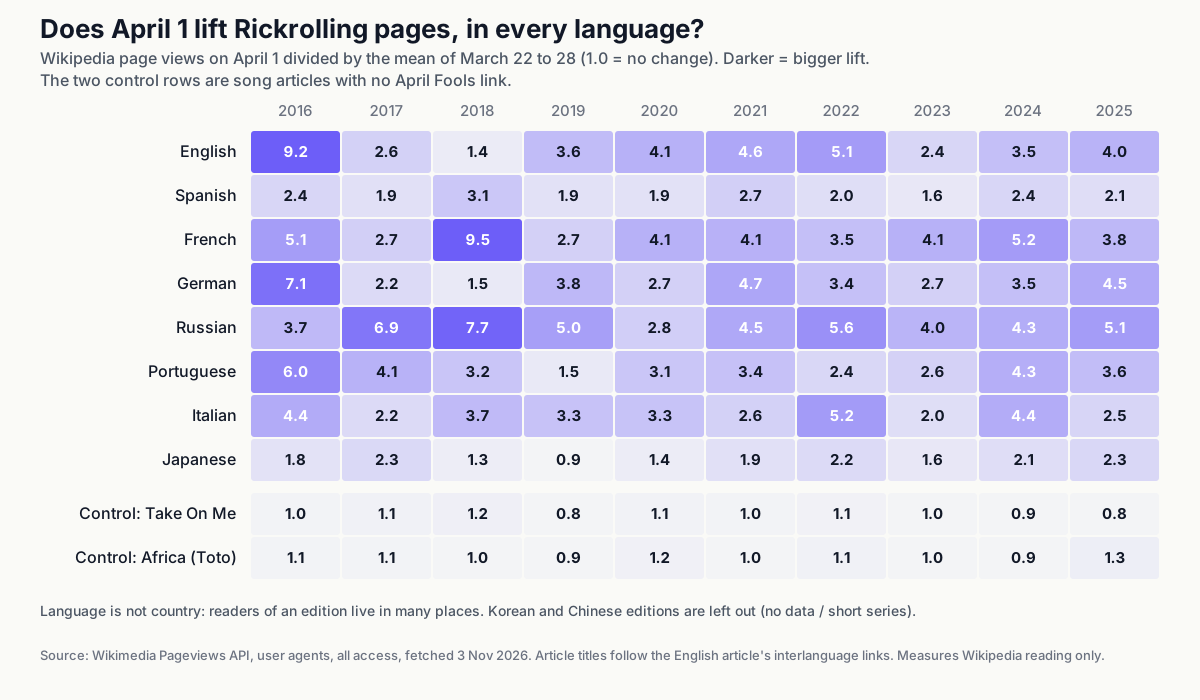
Wikipedia editions are languages, not countries, but they still show whether a meme left English. It did, and almost all editions share the same yearly lift on April 1. In the eight editions with a full series (English, Spanish, French, German, Russian, Portuguese, Italian, Japanese), page views on April 1 beat the average of March 22 to 28 by more than 1.5 times in 94 percent of the 80 language-years measured, with a median lift of 3.3 times.
The exception is Japanese, which has the weakest lift, between 0.9 and 2.3 times, and also the most distinct long-run path: its level in 2024 was three times its 2019 level, while English, Spanish, French, German, Portuguese and Italian had dropped back to or below 2019 by 2025.
The heat grid below carries the control rows. The same measure on the “Take On Me” and “Africa” articles stays near 1.0 in every year.
4. Cross-language evolution: the word travelled, the joke stayed
The prank did not need translating: the song is the joke, and it is in English everywhere. What changed by language is the word. The article titles in the editions measured keep the English word or adapt it to the local script: Rickroll in Spanish and French, Rickrolling in German, Portuguese and Italian, リックロール in Japanese, Рикроллинг in Russian and 瑞克搖 in Chinese. A name that stays recognisable is one reason the meme was able to travel without any local version of the joke.
Some of the largest non-English days were shared with English. The English spike of 18 June 2020, consistent with the Reddit thread of that month (this study did not confirm the exact day), is also among the top days in German and Russian. The one-billion-views milestone of 28 July 2021, covered by NPR among others, put 29 July 2021 on the top-day list in Russian (7,619 views) and Chinese (2,511). Other large non-English days have no cause in the sources used, such as a Russian peak on 17 December 2015 and a Japanese peak on 18 February 2021, and they are left unexplained here.
5. Attention curve: a floor with spikes, not a hill
Most memes in a data series look like a hill: a rise, a peak and a decay. The Rickrolling article does not. It has a floor, the median day, that has stayed between 1,231 views (2025) and 4,002 (2021) in every full year, and the biggest five days make up only about 4 to 8 percent of a normal year’s views. In 2015, 2016 and 2024 they made up 31, 20 and 29 percent, because one event dominated.
The largest day in the whole ten years is 29 October 2024, with 151,106 views, ninety-two times the floor before it, followed by 71,338 the next day. No cause was found for it in the sources checked, and that is stated rather than guessed. The pattern around it is the same as the other spikes: a day or two of surge, a return within about nine days.
The measure carries a seasonal signal as well: April has the highest monthly median across the years measured (about 2,700 views a day against 1,750 in December), the only month that stands out.
6. Revival waves: repeated, not revived
An evergreen meme has no single revival, because it never fully leaves. What the data shows is a trough and a wave. The median English day fell from 2,496 views in 2015 to 1,484 in 2019, then rose to 4,002 in 2021, 2.7 times the 2019 level, and fell back to 1,231 by 2025.
The rise is not an effect of Wikipedia reading in general. The two control song articles did not rise: relative to 2019 their median days in 2021 were 0.87 times (“Take On Me”) and 0.66 times (“Africa”). The article on the song itself rose 2.1 times and the article on Rick Astley 1.5 times. The wave also appears in every one of the eight language editions in 2021, between 2.4 and 4.3 times their 2019 level. So it is specific to Rickrolling and to the artist, and it is shared across languages.
Why is not in the data. The year is the same as the 2020 Reddit thread, the milestone of a billion views and the pandemic, and a connection to lockdown-era time online is a hypothesis, labelled as such below.
7. Remix and mutation: from a trick on strangers to a wink between friends
The first form was a trap: a link that lies. Over time the same song was carried into other formats. QR codes, tested in a study that counted over 1,600 scans of Rickroll codes between May 2013 and March 2014, and still in use in March 2026, when a board exam’s QR code was reported to link to the video. Scoreboards and broadcasts, with a stadium scoreboard in 2019 and an NFL broadcast in October 2019 switching to the song. Fiction, with a 2018 Westworld spoof video and the post-credits scene of Ralph Breaks the Internet. Speech, with the July 2016 convention speech that commentators read as an accidental Rickroll because of the line “never, ever, give up”, and whether it was intended is not established by any source found.
The mutation that matters is the change in relationship. Early Rickrolls tricked someone who did not know. Later ones, such as the 2015 Foo Fighters stunt, are a shared joke where everyone already knows. That change is why the meme did not die when the trick stopped working.
8. Community and creator roles: who did what
Anonymous posters made it, by taking a duck prank and swapping in a song. A platform joined it early: YouTube’s own 1 April 2008 joke sent users to the video, and the original upload was taken down at least three times, in 2010, 2012 and 2014, according to press cited on Wikipedia. The press made it known, and sometimes wrong: the 2008 New York Times story was later retracted. The artist took the part the sources show most clearly: he spoke about it publicly in March 2008, appeared on the November 2008 parade float, declined to attend the MTV Europe Music Awards where he had won “Best Act Ever” after an online vote, and in 2023 played Glastonbury and talked about the meme. Other musicians used it as a protest tool: in August 2015 the Foo Fighters drove up to a Westboro Baptist Church protest at their Kansas City concert playing the song, and the church replied on social media that it had been Rickrolled.
Institutions appear first as victims, then as participants: the New York Mets’ online vote in April 2008, the US Congress’s YouTube channel in January 2009, the White House’s Twitter account in July 2011, a House Judiciary Committee post that was deleted in February 2025. Brands came later, with a 2022 insurer ad featuring Astley and a QR code.
Roles are defined here by what each party did, not by follower counts, which were not measured.
9. Evidence and confidence: what is observed, what is inferred, what is unknown
A. Observed. The daily page views in the figures above are direct data. The dated events are from named press reports, collected on Wikipedia’s Rickrolling article; Wikipedia itself is a secondary source, and details such as the uploader’s identity are repeated rather than independently confirmed here. The Foo Fighters event, the one-billion-views milestone, the 2020 Reddit post and the 2016 speech were each checked against at least one news report.
B. Supported inference. The April 1 lift is specific to Rickrolling, because the same measure on two other song articles stays near 1.0 and on the song and the artist is about 2. A link to April Fools’ Day through YouTube’s 2008 joke is plausible, but this data cannot prove it. The 2021 wave is specific to Rickrolling and the artist, not general Wikipedia reading, because the control articles did not rise.
C. Hypotheses, not tested. That the 2020 to 2022 level reflects more time online during the pandemic. That the July 2016 spike was a political-news effect rather than a meme one: the speech was also covered for plagiarism, so the Rickroll reading may not explain all of the views.
Unknown. The cause of the 29 October 2024 spike; the share of the video’s billion views that came from Rickrolls, which no source has worked out; and anything about 2007 to 2015, the period when the meme was growing, which this data does not cover.
What this shows about reading any meme
Comparing this study with the Mariah Carey one shows two different shapes. A calendar meme concentrates its attention on one date and can be measured by a step. An evergreen meme has a floor and waits for a trigger, and the trigger can be anything from a band’s stunt to a political speech.
So the first question to ask of a meme is not how big it got, but what kind of return it has: a date, an event, or both. Rickrolling has an event return and, from an accident of 2008, one date. Each needs its own measure, and a control, to tell a real pattern from a general rise in Wikipedia reading.
Frequently asked questions
Who invented the Rickroll? The usual account credits a 4chan user who, on 15 May 2007, posted a link to Astley’s video disguised as a Grand Theft Auto IV trailer, building on the earlier duckroll prank. Accounts of the details differ, and this study did not find a source that settles who first used the song.
Is the Rickroll still popular? Reading of the English article was at its lowest daily median of the decade in 2025 (1,231 views), but the Rickrolling article keeps being read in eight languages, and it still jumps on April 1 and when an event revives it.
Why April 1? YouTube’s own April Fools’ prank of 2008 sent users to the video, and the article’s page views have jumped on April 1 in almost every language-year measured. The data shows the date effect, not why it began.
Did the singer mind? The press record shows him talking about it in 2008, appearing on a parade float that November and discussing it in later interviews; his own account is best read in his interviews and memoir.
Final thought
The Rickroll lasted because it stopped being a trick. It became a shared reference that everyone knows how to use, and that reuse is what the numbers show: a floor that does not fall to zero, spikes that follow events, and a day each spring when many language editions rise together. The 2007 boom is not in this data, and the pandemic-era rise has no proven cause. What the data does say is that the meme was never one wave. It is a stock of attention that events draw down and that readers keep refilling.
SOURCES
- Wikipedia: Rickrolling — Dated chronology 2006 to 2026 with the press reports it cites: duckroll, May 2007 upload, 2008 spread, 2009 to 2014 video removals, 2015 Foo Fighters, 2016 speech, 2020 Reddit, 2021 milestone, 2025 to 2026 uses
- NPR: Rick Astley’s hit passes 1 billion views on YouTube (30 July 2021) — The one-billion-views milestone reported on 28 July 2021
- Time: Foo Fighters rickroll Westboro Baptist Church protesters — The August 2015 stunt in Kansas City
- Rolling Stone: Watch Foo Fighters rickroll Westboro Baptist Church — Second report of the 2015 stunt
- WTVR (24 August 2015): Foo Fighters rickroll Westboro Baptist Church — Coverage date consistent with the 24 August page-view peak
- TheWrap (July 2016): Did Melania Trump rickroll us with her RNC speech? — The Rickroll reading of the convention speech, alongside the plagiarism story
- Input (December 2020): Rick Astley has won Reddit’s top post of 2020 — The 2020 Reddit post and the Rickroll in its comments
- Wikimedia Pageviews API: English Wikipedia, Rickrolling, daily, user agents (query used) — Source of every page-view figure; the other editions and control articles were pulled the same way